Dental implants in Cirencester and Stow-on-the-Wold
A dental implant is a small titanium post that takes the place of a missing tooth root. Once your jawbone has bonded to it, it holds a crown, bridge or denture firmly in place.

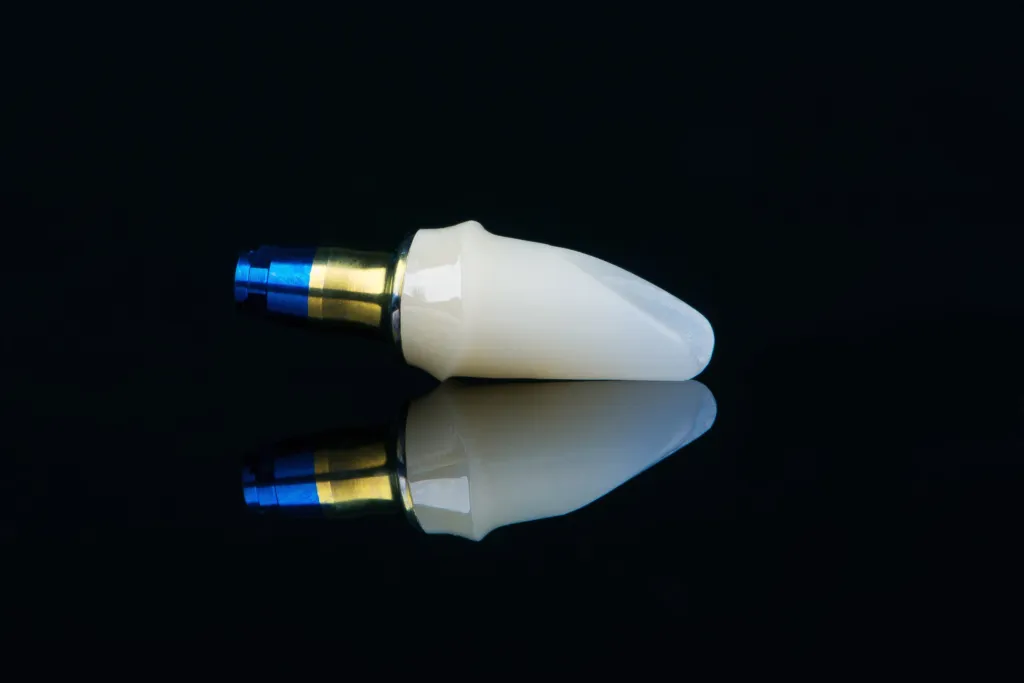
- The crownthe tooth you see
- The abutmentthe connector at the gum line
- The implanta titanium post in the jawbone
What is a dental implant?
When you lose a tooth, you lose its root as well as the part you can see. A dental implant replaces the root. It is a small titanium post, shaped like a screw, that is placed in the jawbone where the tooth used to be. Once it has healed in place, a crown, bridge or denture is attached to it.
The kind of implant used most widely around the world is called a root-form, or endosseous, implant. "Endosseous" simply means "within the bone". It is roughly cylindrical and usually has a screw thread on the outside, which helps it sit firmly when it is placed.
An implant tooth has three parts:
- The implant: the titanium post in your jawbone, in place of the root.
- The abutment: a small connector that fixes onto the implant and comes through the gum.
- The crown, bridge or denture: the tooth or teeth you see, made to suit your mouth.
How do implants work?
Titanium is biocompatible, which means the body accepts it well. In the weeks after an implant is placed, the bone grows closely around its surface and bonds to it. Dentists call this osseointegration. Once it has happened, the implant is held firmly in the bone and can take the forces of biting and chewing.
The abutment is then connected, and your new teeth are fitted on top. If you are replacing one tooth, that means a single crown. Several teeth in a row can be replaced with a bridge held by two or more implants. If you have no teeth left in a jaw, implants can hold a fixed bridge, or a denture that clips securely in place so that it no longer slips.
Implants usually settle for 6 to 12 weeks before your new teeth are fitted, and longer if you need bone grafting first. In some cases, temporary teeth can be fitted at the time the implant is placed or soon after.
Who are dental implants for?
Implants can replace one tooth, several teeth or every tooth in a jaw. They suit most adults whose jawbones have stopped growing. If the bone is too thin, it can often be built up first with grafting.
They are a good option if your mouth is otherwise healthy and you have lost a tooth or teeth through decay, gum (periodontal) disease, an injury or another reason. Three things matter most.
- Enough healthy bone. After a tooth is lost, the bone that held it slowly shrinks. A CBCT scan (a 3D X-ray) shows exactly how much bone there is and where. If there isn't enough, it can often be rebuilt with a bone graft or, in the upper back jaw, a sinus lift. Bone grafting and sinus lifts →
- A healthy mouth. Implants do best in a healthy mouth, so any tooth decay or gum problems are treated first. Teeth that can't be saved are usually best removed early, because they can harbour bacteria.
- Your habits. Smoking and heavy drinking reduce how well implants (and natural teeth) survive and raise the risk of an implant failing. We'll talk this through with you honestly.
You'll know whether implants are right for you after your consultation, once we have examined your mouth and, if it's needed, taken a 3D scan.
Your options
Which treatment you need depends on how many teeth are missing and where. Each option has its own page with more detail.
One missing tooth
- What it replaces
- One tooth
- What's involved
- One implant and one crown
Several missing teeth
- What it replaces
- Two or more teeth, usually side by side
- What's involved
- A bridge supported by two or more implants
All the teeth in a jaw
- What it replaces
- Every tooth in the upper or lower jaw
- What's involved
- A fixed implant bridge, a removable implant bridge, or a denture that clips onto implants
Implants, bridges and dentures compared
There is more than one good way to replace missing teeth, and an implant isn't right for everyone. Here is a fair summary of how the main options compare. At your consultation we'll go through the ones that suit you.
Dental implants
Implants are fixed in the jawbone and are not attached to the teeth next to them. That brings some real advantages:
- They look, feel and work much like natural teeth.
- Healthy neighbouring teeth don't need to be cut down to hold a bridge.
- They help prevent further loss of jawbone where the tooth used to be.
- Dentures held by implants no longer move around.
- Many people find it easier to speak, eat and smile with confidence again.
There are things to weigh up too. Placing an implant is a surgical procedure, usually done under local anaesthetic, and there is a healing period of several weeks before your new teeth are fitted. You need enough healthy bone, or a graft first. Implants cost more at the outset than a denture. And they need the same daily cleaning and regular hygienist visits as natural teeth, because the gum and bone around an implant can be affected by gum disease.
Bridges fixed to your own teeth
A conventional bridge is cemented to crowns on the teeth either side of the gap. It is fixed in place and needs no surgery, but the teeth either side have to be cut down to take the crowns. Over time those crowns can loosen and decay can develop underneath. An adhesive bridge is bonded to the back of a neighbouring tooth with metal wings, so little or no cutting is needed. It can come loose, though, so it is often seen as a shorter-term option.
Removable dentures
A removable denture uses acrylic teeth to fill the gaps. It is relatively inexpensive and needs no surgery. Dentures can feel less secure, though, and some people need adhesive to hold them in place. A partial denture can contribute to decay and gum disease in the teeth you still have, and dentures can speed up the shrinking of the gum and bone underneath.
The implant systems we use
We only use established implant brands, such as Straumann®. Dr Ross Cutts, who leads our implant team, is a Fellow of the International Team for Implantology (ITI) and works closely with the Straumann system.
Careful planning matters as much as the implant itself.
- CBCT 3D scanning. A cone beam CT scan gives life-size, three-dimensional images of your jaw, so the position, depth and angle of each implant can be measured and planned before treatment begins. Scans are taken at our Cirencester practice. About CBCT scans →
- iTero digital scanning. A small hand-held wand records precise digital impressions of your teeth, often without traditional impression trays. About iTero scanning →
- Trusted laboratories. Your crowns, bridges and dentures are made by the dental laboratories we work closely with, including Borough Crown & Bridge and TPR Dental Prosthetics.
Implant treatment is available at both our Cirencester and Stow-on-the-Wold practices. Just tell us which you'd prefer when you book.
What do dental implants cost?
Every patient receives a written, fully costed plan before treatment begins. These are the main fees from our August 2026 price list.
| Item | Details | Price |
|---|---|---|
| Initial clinical consultation (30 minutes) | A full examination of your mouth and a talk about your options. You receive a fully costed plan for your treatment and a letter explaining the whole procedure. | £95 |
| Initial clinical consultation with Dr Ross Cutts (30 minutes) | The same full consultation, with our principal dentist, Dr Ross Cutts. You receive a fully costed plan for your treatment and a letter explaining the whole procedure. | £150 |
| CBCT 3D scan (at our Cirencester practice) | A 3D X-ray of your jaw that shows the shape and depth of the bone, so implants can be planned precisely. Charged in addition to the consultation, only if a scan is needed. | £210 |
| Implant fixture (the post that goes into the bone) | The implant itself: a small titanium screw placed in the jawbone to take the place of a tooth root. Priced per implant. | £1,595 |
| Implant crown, back tooth | The crown (the visible tooth) made for and fitted on top of an implant, for a back tooth, including the abutment that connects the two. | from £1,345 |
| Implant crown, front tooth | The crown (the visible tooth) made for and fitted on top of an implant, for a front tooth, including the abutment that connects the two. | from £1,345 |
A single implant and crown starts from £2,940. Replacing several teeth, or all the teeth in a jaw, depends on how many implants you need and the type of teeth fitted, so we price it after your consultation. If you need bone grafting, that is added to your plan and explained before you decide.
You pay in stages as your treatment progresses, rather than all at once.
Questions about dental implants
What is a dental implant?
A dental implant is a small titanium screw that takes the place of a missing tooth’s root. It is placed in your jawbone, and over the following weeks the bone bonds to it. Dentists call this bonding osseointegration. Once the implant is secure, a connector called an abutment is fitted, and this holds your new crown, bridge or denture. A denture held by implants doesn’t slip around, and implant crowns and bridges work much like natural teeth. Implants can replace a single tooth, several teeth or all the teeth in a jaw.
Why replace a missing tooth?
Teeth are lost for many reasons: decay, gum disease, accidents, wear with age, a condition you were born with, or a serious infection such as a failing root canal treatment. Whatever the cause, a gap can lead to other changes. Without a tooth to stimulate it, the jawbone underneath slowly shrinks. The teeth either side can tilt and drift into the space, which can upset your bite and change how your smile looks. Over time this can make chewing harder, affect what you eat and leave you feeling self-conscious. We can talk you through the options for filling the gap.
What are my options for replacing missing teeth?
It depends on whether you still have some of your own teeth. If you have no teeth left in a jaw, the options are a removable denture, a denture held in place by implants, or crowns and a bridge supported by implants. If you have some teeth left, you could have crowns or a bridge supported by implants, your own teeth or both; a partial denture secured by implants or by teeth; or a bridge fixed to the teeth either side of the gap. At your consultation we’ll explain which options suit you, and what each involves and costs.
How do implants compare with dentures and bridges?
Each option has strengths and drawbacks. Removable dentures cost less, but they often need adhesive, can feel loose or uncomfortable, and can add to decay, gum disease and shrinkage of the bone and gums. An adhesive bridge needs little or no drilling of the teeth next to it, but it can come loose, so it is often seen as temporary. A conventional bridge means filing down the healthy teeth either side of the gap to hold it, and over time these crowns can loosen and lead to decay. An implant isn’t attached to the teeth next to it, so they are left untouched, and it can be combined with bone grafting where needed.
Are implants safe, and how long will they last?
Implants are a well-established, tried-and-tested treatment. Like natural teeth, how long they last depends largely on how well you look after them and whether you keep up your regular hygienist and check-up visits. If they aren’t cleaned well, a coating builds up around them, just as it does on neglected teeth, and this can lead to gum infection, bleeding and soreness. With good care, and strong, healthy bone around them, implants can last for many years. But as with other implants in the body, such as a hip replacement, there is no lifetime guarantee.
Does having an implant hurt?
Implants are usually placed under a local anaesthetic, which numbs the area while we work. Afterwards, much as after having a tooth out, you may have some discomfort in the week after surgery, such as a dull ache, swelling or slight bruising. How much depends on how many implants you have and how involved the surgery is. If you’re very nervous, or your treatment is complicated, intravenous (IV) sedation is available to help you feel deeply relaxed. General anaesthetic is rarely used for implants, and only for very complicated cases.
Will people be able to tell I have implants?
The implant itself sits in the jawbone, under the gum, so it can’t be seen. What shows is the crown, bridge or denture fitted on top. This is made for your mouth by dental laboratories we have worked with closely, so that the finished result looks as natural as possible. We’ll talk through how your new teeth will look at your consultation, before any treatment starts.
Can I take my implant teeth out?
It depends on the type. Most crowns and bridges fixed to implants can only be fitted and removed by your dentist, so they stay in place from day to day. If you have a denture that clips onto implants, you can take it out yourself to clean it. If you’ve lost all the teeth in one jaw, there is also a removable implant bridge, which you take out to clean. We’ll explain the differences at your consultation.
What happens if an implant doesn't bond with the bone?
Sometimes an implant doesn’t fuse with the bone and becomes loose, either while it heals or shortly afterwards. If that happens, it can be removed easily and your jaw heals in the normal way. Once the area has healed, another implant can be placed there. Or, if you have several implants, a bridge can be made using the implants that have bonded. We’ll talk you through what this would mean for you.
Can an implant fail later on?
It can. Implants can’t decay, but like teeth they can develop gum problems, and bone can sometimes be lost around them. If that bone loss keeps progressing, the implant may be lost. Smoking and heavy drinking both reduce how long implants, and teeth, survive. Your protection is thorough daily cleaning, regular hygienist visits, which reduce the risk, and check-ups, so that any problem is found early, when it’s easier to treat. If an implant is failing, we’ll plan the next step with you.
What if my implant is damaged in an accident?
Implants and the teeth they hold can be damaged in an accident, just like natural teeth. If you play contact sports, or sports with a ball, wear a mouthguard made by your dentist. If only the crown or bridge is damaged, it can usually be removed from the implant and replaced. If the titanium implant itself is damaged beyond repair and is too difficult to remove, it can safely be left in the jaw, and another implant placed alongside it.
Which implant systems do you use?
We only use established implant brands, such as Straumann®. Dr Ross Cutts works closely with the Straumann system and has experience with many others. Your crowns, bridges and dentures are made by dental laboratories we work closely with, including Borough Crown & Bridge and TPR Dental Prosthetics, so that they look as natural as possible and suit you. We’ll tell you which system we recommend for you, and why, at your consultation.
Will I need traditional impressions (moulds) taken?
Often not. We use an iTero digital scanner, which records your teeth with the tip of a small hand-held wand instead of a tray of impression material. You and your dentist can watch the scan build up on screen, and the computer turns it into a three-dimensional model of your teeth. This is used to make your crowns, bridges and implant teeth, without the mess or taste of traditional moulds.
Am I suitable for dental implants?
Most adults can have implants once their jawbones have stopped growing. They suit people in good general oral health who have lost a tooth or teeth through decay, gum disease, injury or another reason. The main question is whether there is enough healthy bone in your jaw to hold an implant. At your consultation we’ll examine you and arrange the tests needed, such as X-rays or a CBCT 3D scan, to see how much bone there is. If there isn’t enough, it can often be built up first with bone grafting.
Find out whether implants are right for you
A 30-minute consultation includes a full examination and an honest view of your options, followed by a fully costed plan. It costs £95, or £150 with Dr Ross Cutts.