
CBCT 3D scans and dental X-rays
Precision, not guesswork. A CBCT scan shows your jawbone in three dimensions, so your implants can be planned precisely.
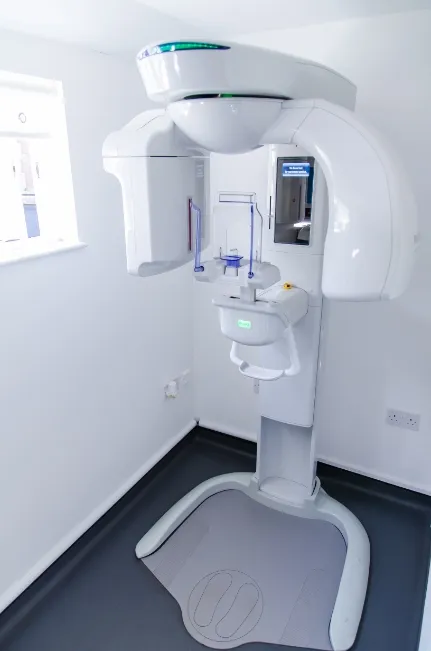
What is a CBCT scan?
CBCT stands for cone beam computed tomography. It is a special kind of X-ray that produces 3D images of your teeth, jawbone and the structures around them.
The everyday dental X-rays most people are familiar with are two-dimensional, and can be distorted. That matters when we need to plan around important structures, such as nerves, that must be avoided. A CBCT scan gives life-sized, three-dimensional information about your upper and lower jaw, from which precise measurements can be taken for planning. With it, we see the shape and depth of your bone before treatment begins.


What it's used for
A CBCT scan helps your dentist:
- check whether you're suitable for dental implants
- check the quality of your bone before implants are placed
- find the most suitable place in the jawbone for each implant
- see your sinuses in 3D, to judge whether you need a sinus lift
- see the position of nerves and blood vessels
- check how a bone graft has healed before implants are placed
- assess wisdom teeth before they are removed
- plan other treatment, such as measuring the exact length of a root canal
Do I need one?
Not everyone does. Your dentist will tell you at your implant consultation whether a scan would help in your case, and it is charged separately only if it is needed.
CBCT scans are taken at our Cirencester practice only. If you are being treated at Stow-on-the-Wold, your scan will be taken at Cirencester.
OPT (panoramic) X-rays
An OPT, also called a panoramic or panoral X-ray, is a single, two-dimensional image of your whole mouth. It shows areas that an ordinary dental X-ray can't, including:
- the entire upper and lower jawbone
- the nasal sinuses and the bone around them
- the nerve that gives feeling to your lower jaw and gums
- the jaw joints (temporomandibular joints, or TMJ)
OPT X-rays are also taken at our Cirencester practice only.
Fees
A CBCT 3D scan is £210, taken at our Cirencester practice.
| Item | Details | Price |
|---|---|---|
| CBCT 3D scan (at our Cirencester practice) | A 3D X-ray of your jaw that shows the shape and depth of the bone, so implants can be planned precisely. Charged in addition to the consultation, only if a scan is needed. | £210 |
| CT radiology report by a consultant radiologist | A written report on your CBCT scan by a consultant radiologist, where one is needed. | from £195 |
| OPT (panoramic) X-ray | Taken at our Cirencester practice. | £55 |
An OPT X-ray is £55. If a report on your scan by a consultant radiologist is needed, this is from £195. Any scan you need is included in your written, fully costed plan. See all fees.
Questions about scans and X-rays
What tests will I need before my treatment is planned?
To plan your treatment properly, we usually need photographs, X-rays and models of your teeth and jaws. In some cases we’ll also recommend a CBCT scan, a 3D X-ray that shows the shape of your jaws in much more detail than an ordinary X-ray. The planning stage, up to your written plan, may take a month or so. If you need any treatment first, we’ll explain it in your plan.
What is a CBCT scan?
A CBCT (cone beam computed tomography) scan is a type of 3D X-ray. Ordinary dental X-rays are flat, two-dimensional pictures, which can distort or miss detail. A CBCT scan gives life-sized, three-dimensional images of your upper and lower jaw, so we can take precise measurements and plan where your implants should go, avoiding nerves and other important structures. It can also be used to check a bone graft before implants are placed. Our CBCT scanner is at our Cirencester practice.
What is a CBCT scan used for?
A CBCT scan helps us plan treatment in three dimensions. For implants, it’s used to check whether you’re suitable, assess the quality of your bone, find the most suitable place in the jaw for each implant and look at the sinuses, to judge whether a sinus lift is needed. It also shows where nerves and blood vessels lie. Beyond implants, it helps when assessing wisdom teeth before removal, and can show the precise length of a tooth’s root canals for root canal treatment.
We also take CBCT and OPT scans for other dentists' patients, at Cirencester. See CBCT scan referrals.
Start with a conversation.
Book a consultation to talk through your options. You'll leave with a clear, fully costed plan to take home and think over.